


Our friend Nell has a problem. Her chickens are old enough to be laying–and they do that butt shuffle thing when I go to pet them, which ours started to do when they began to lay. My feeling is that these girls have got to be making eggs. Unfortunately, every morning Nell goes out to gather some breakfast the nesting boxes are empty. After Meg and I did some investigating this is what we know is not happening:
1. The chickens are not eating their own eggs. There are no broken shells or yolk on their faces.
2. The chickens are not hiding the eggs. Trust me, we looked.
3. There is no mess.
4. The chickens are unharmed.
This is what is happening:
1. The inside of their pen has a bunch of holes in the ground that are about three inches in diameter. The holes are deep and some look like they lead under the coop and others look like they go under the fence.
2. Nell is getting pissed.
Meg and I figure that it has to be rats. Unfortunately this isn't Templeton we're dealing with, or I would maybe suggest to Nell that she try to reason with him. Neither Meg nor I have ever had to deal with rats so we are pretty short on answers for what to do. All we do know is that something should be done, but the safety of the chickens is a glaring concern. We thought of traps, but I know it wouldn't take long before Nell had a bunch of chickens with broken necks, and I'm worried about poison as well, because for some reason I envision the result would be nothing short of a Greek tragedy.
By gosh and golly what should she do?
10 January 2009
What if Nell has Rats?

22 August 2008

20 August 2008
Nasty Little Bastards

Squash vine borers demolished our very tasty Striata d'Italia summer squash this year. We knew it was doomed a few weeks ago, but I was harboring false hopes of recovery. After a week of increasingly wilted leaves and droopy flowers, we yanked it. 
The stem was completely eaten and rotted out and inside it held—surprise!—a couple of big, fat vine borers. These squirmy things eat the plant from the inside out and steal water and nutrients that would otherwise keep the leaves perky and allow new fruit to set. Our extremely prolific Lemon squash is naturally bug-resistant, so it's still doing fine. The cucumbers, melons, and winter squash are also hanging in there, so they are still chugging along in the garden. The vine borers, meanwhile, gave us a nice occasion to have a campfire.
14 August 2008
While she was at work
Meg and I usually have our schedules set up so we can maximize our home time together, but sometimes it doesn't work out that way and one of us will find ourselves alone at home for a good chunk of time. For me, today was one of those days.
I should have used the time to draft my syllabi for the fast approaching semester, but instead I spent my afternoon in the garden.
My first order of business was to find where a tomato eating groundhog was getting into our garden and plug the hole. When I look at this tomato it reminds me of The Old Man and the Sea. It's a little depressing.
I then spent some time clearing a few exhausted beds for our fall planting. The beds pictured above and below will probably be for greens and carrots.
We're not sure how we're doing on time, but our first frost seems to come later every year, so we're hoping that we'll be able to squeeze in a decent harvest.
Speaking of harvest, while gathering the green beans, I found this soon-to-be-smashed little fella. The beans seem to have caught a second wind. I was ready to give them a pull a week or so ago, but out of nowhere they just started to flower again and completely veg out. You know when you get in to a picking zone and your eyes and hands just seem to hone in on whatever you've got goin'? Well I was in such a zone and almost picked this guy thinking it was a bean. This year we had a lot of these beauties call our garden home. Now we just need to work on attracting more lady bugs.
21 July 2008
Another One Bites the Dust

This is the pupae of a tobacco hornworm. We found (and squashed) a handful of these in May.
This is a tobacco hornworm that apparently escaped being squashed in May. He didn't have the same luck tonight.
15 July 2008
Oh Hell
Disasters in our garden are never minor. Never. The first year it was groundhogs, drought, and incompetence. The second year it was squash bugs and black walnut poison. This year, well, we're not sure what it is but we don't like it. Below are some shots of a squash plant and tomato plant that are looking terribly suspect. We have a list of possibilities and what their causes are, but no solutions. Meg believes it may be some kind of mosaic virus on both plants, but can't say for sure.
If any of you know what the hell is going on and maybe know of a solution that doesn't require moving, we'd greatly appreciate it.

The squash leaves that look like this feel brittle and dry. The stems leading to the leaves look okay, and there is no insect damage on them.

 The worst looking tomato leaves are towards the bottoms of the plants, and they feel tough and kind of leathery. No bugs on them, either.
13 July 2008
The Plan

The trees on our rented property seriously handicap our ability to properly rotate crops. Our garlic is one crop that has to be planted in the same area until we can fence the garden in. Right now the area is pretty open and we need to provide safety for our more vulnerable plants. So, in order to keep up the organic matter we developed a plan.
For the next week or two we will be running the chicken tractor* over the beds. This will help reduce the weeds and nasties in soil and also give it a nitrogen boost from their crap. Afterwards we will plant a cover crop and then turn it in when we plant more garlic in the Fall. A combination of the green manure and chicken shit should keep everything in check.
*Reduce, Reuse, Renew leaves little tolerance for those who are aesthetically driven. However, even with that said, please excuse the comedy of our fitted sheet.
06 July 2008
This bug died


These photos are of a squash bug and its eggs. These little shits destroyed our entire crop last year. What they do is suck out liquid from the squash's stem and at the same time release a poison that will eventually kill the plant. There is a 10-14 day window between when the eggs are laid and their unfortunate hatch. Last year we didn't know what to look for, but now we do and we are addressing them early. Our approach to containing these things is simple, but kind of labor intensive.
When we direct seeded earlier in the spring, we also planted nasturtiums, because apparently they work as a deterrent. As the photos indicate, so far, not so effing good. We don't have a lot of squash bugs (last year was awful), so maybe there is some proof in the pudding. The meticulous bit of our control mission is to check under the leaves (oh yeah, that's where they do business) twice a week and smash them when we find them. Now granted, we have a decent sized garden, but anything larger than this and I would have to say, "eff this," to the hand to bug combat.
If you're not down with smashing them or pollinating the plants by hand (that's another alternative that requires the use of row covers), the best thing to do is practice preventative maintenance during fall clean up and mulch heavily in the spring. We did both, but our infestation was really bad last year so it may take a while before we can convince them all to pack up and go. If you've got them, good luck.
22 June 2008
Chicken Tractor, or, Meat Sounds

The chicken tractor is built. It only took a few hours to do, and now we can finally put the chickens to work on something other than breakfast. It would be nice to let them completely free range, but we have neighbors who would think that's a bad idea. What we plan to do is toss the ladies in the tractor every morning and park it on a bare garden bed or under some trees*. After years of neglect, there is a fair amount of bad shit crawling about this place and we, with the chickens' help, aim to improve the situation.
*Have you ever heard the sounds a chicken makes when it eats a really fat grub? Imagine someone eating a raw steak with their mouths open. It may not be as loud, but yeah, it's nasty. I just have to remember that the slurping makes the eggs taste better. Shit, that doesn't help at all.
13 June 2008
Battle for the brassicas

Last year everyone of our brassicas was molested to ruin by a flock of cabbage moths and their demon worm spawn. This year we installed some spun forcefields (just say no to chemicals) and victory is ours. We just harvested our first head of broccoli and it was effing delicious.
08 June 2008
At the First Sign of Danger

Potato beetles suck. This striped little shit did not receive the same affection as did the mice we found yesterday. Oh no siree. We squashed him (or her, I really don't care) proper.
07 June 2008
An Unfortunate Disturbance
 It was effing hot today. Our greens weren't to happy about it so we brought out the shade cloth to kind of ease the pain. For convenience we keep the cloth balled up in the lower shed. I carried the wadded mass into the garden and when I unfurled it I saw a large mouse fall to the ground and scurry through the fence.
As I started cursing out the little bastard for chewing a hole in the sheet, I heard a little squeak that instantly made me feel remorse. I knew what it was and a short scan of the ground revealed what I feared. The little bastard that ate a hole in our sheet was nesting with a pair of her own little bastards.
When I showed the tots to Meg, she asked if I was going to kill them. I answered no, even though I knew I already had. I set them down where I saw their mother retreat (hopeful), but when I checked back a few hours later they were still there, just kind of squirming a bit.
I don't know why I felt sad, they really are bastards. I think perhaps it's because they never had the chance to live and really piss me off. Oh well. Little bastards.
28 May 2008
Good fences make good neighbors, and all that.
This is a long one.
Our neighbor is crazy. And I'm not using that word in the colloquial sense, as when you sometimes describe a person as "crazy," when what you really mean is that the person is emotional, or passionate, or eccentric. No, our neighbor is crazy.
We have numerous stories to back this up, but one has been particularly enduring. Last summer, before the craziness had fully presented itself, she came to talk to us while we were working outside. She mentioned the pine trees that are on her property—but right up against our garden—and she asked if they blocked out our sun too much. They didn't block the sun much, but they did hang way over the garden and drop pine cones and crap all the time. She said she'd get her husband to cut them back so we didn't have to—but we could if we wanted to.
So, last October, I cut back the branches that were coming into the garden.
That was fine until one day in March when I went outside to feed the chickens and heard her screaming at our landlord, "This is all I have, Christopher! This. Is. ALL. I. HAAAAAAAVE!!" She was talking about the trees, of course, which she had just noticed. Needless to say, I got the hell out of there.
A few weeks later her husband cut back the trees even more than I did, and she came over while we were outside to shout, "Hey! You call that bein' a neighbor? 'Cause I call that NOT BEIN' a neighbor!" Oh, well then. Ever since, we've been privy to dirty looks and shouted conversations of, "Hey! When's that fence guy comin'?" Yesterday she stood on her porch in her pajamas and stared at me through a gap in the trees for ten minutes. It's been fun.
Today, though, the fence guys came. They were very nice and they loved our garden, but most importantly they put up a 7-foot tall privacy fence (which necessitated cutting back the trees even more, incidentally). Sadly, the fence obstructs our view of the old trampoline, the plastic tarp stuck up in a tree, the trash cans in the middle of the yard, and the neighbor sunbathing on the driveway. But that's the price we'll have to pay. For, you know, not bein' neighbors. At least we'll have the memories.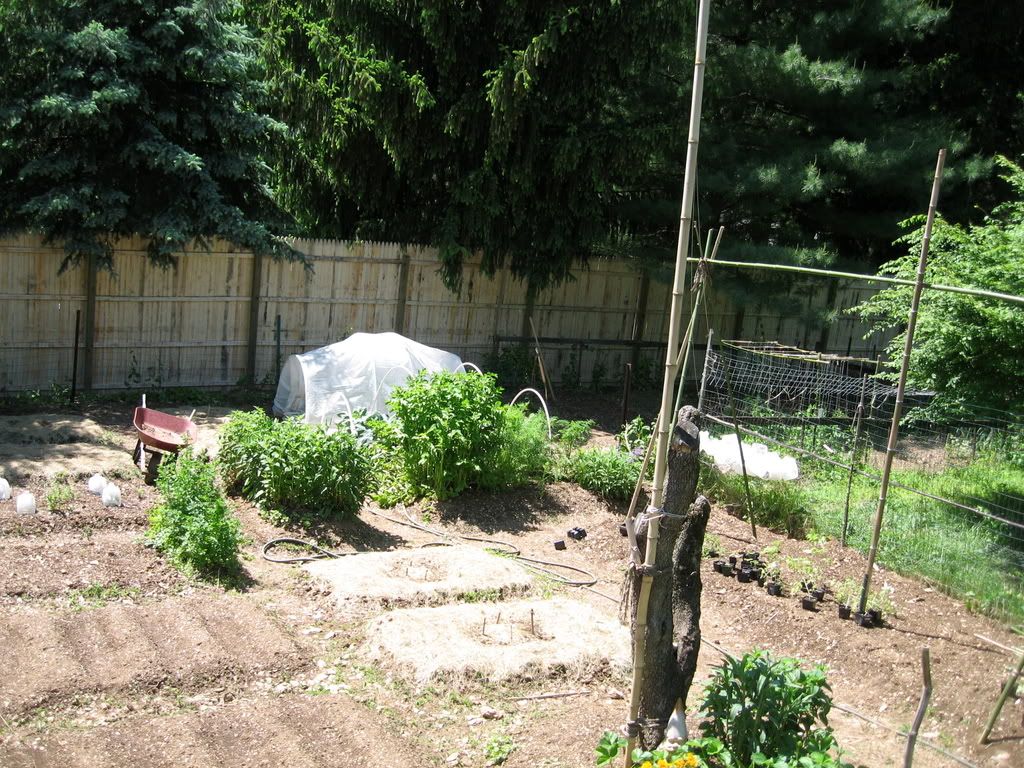
21 May 2008
Stay away bugs

Last year the cabbage worms made a mess of our brassicas. This year we made row covers. Since the brassica family produces without the assistance of pollinators, it is safe to keep them covered with a material that will only let in light, wind, and rain. We're using agribon.
The construction couldn't have been easier. We purchased one-foot sections of rebar and hammered them in around the perimeter of the beds in question. We left about three inches or so poking out and these little nubs then acted as anchors for the eventual ribbing for the structure.
The ribs are eight and ten foot lengths of recycled 3/4 inch PVC. Each end of the PVC slips over the rebar forming a frame that looks similar to that of an old covered wagon.
We couldn't find agribon wide enough to span the width of the beds with the ribs so we fastened two lengths together with clothes pins. After draping them over the ribs we weighed down the edges with strategically placed rocks. The whole shebang cost about $25. All that's left to do is keep our fingers crossed that no other mysterious pests materialize.
20 April 2008
What the hell is this?

After witnessing the fantastic results of Meg's pruning the other day, we thought we would scope out any other trees that need some lopper love. On our journey we spied a mass of eggs left by some kind of insect mathematician. They're cool looking, but if it's bad I want to squish it. Chances are it's a pest (that's just the way this place works), but if it so happens to be a pest eater, well then I think we may want to let it live (I'm convinced that God is a gardener).
If any of you know what in the blazes these damn things might be, before they hatch, please send us a shout.
15 April 2008
Brassicas and Homemade Cloches

Our brassicas have found their way into the garden. In the bed at the top of the photo we have six broccoli and six white cabbage and in the bed at the lower portion of the photo we have six Brussels sprouts and six red cabbages. We grouped them together like this for both protection and production purposes. If we can, I think we may try to squeeze some sage in there as well. We'll see.
Last year cabbage worms destroyed our brassicas, leaving very little for us to actually harvest. This year we purchased floating row covers to keep out the moths that lay the eggs that eventually become the kraut eatin' worms. From what we've read in books and heard at the farmer's market, row covers are extremely effective. However there is one set back and that is they also keep out beneficial insects that are necessary for pollination with some plants.
Luckily brassicas don't need to be pollinated to produce the goods. We figured that if we kept all the brassica beds free of plants that need pollinating we wouldn't need to worry. ( I know, we're doing rocket science over here.) Sage is also a deterrent of cabbage moths so we may plant some of it around the edges to discourage any insect sneakiness.
Another bit or protection we are looking for is against the elements. Although we hardened our plants off, we wanted to play it safe in case there were any surprise temperature drops in the next couple of days. Since the end of last year's growing season, Meg's parents have been saving water and milk jugs for us so we could carve them into cloches.
After we finished planting and had a little lunch, I set to work with our trusty utility knife and cut the bottoms off of twenty four jugs. It is now three days later and they are doing awesome. Our average lows at night have been around 38°. We figure that by Thursday the plants should be completely hardened off and we can remove the cloches and save them for our tomatoes and peppers.
09 April 2008
What's Eating You?
 One of the many things we've learned since we started gardening is that with the great joys there are also extreme aggravations. This property can be a real pain in the ass sometimes. Our recent bit of fury comes from a mysterious pest that is eating the pea sprouts.
I think we can rule out groundhogs, deer, and rabbits. There is just too much fence for that to be a possibility. Meg thought perhaps that is was the work of squirrels, but what ever it is, it left the seed. Actually there doesn't seem to be any mammal amounts of digging at all. I did see an ant colony, but it was in another bed all together. I know they're industrious, but would they really travel that far for a little green grub?
If you can't tell, we are at a loss with this one. Now I know the photo of the eaten sprout isn't the best, but it was the best I could do. If any of you have a theory about what it might be, please send a remedy our way.
08 April 2008
Aha
Recently, Kylee at Our Little Acre posted about cedar-apple rust, a disease that lives alternately on cedar trees and apples trees. The trees take turns re-infecting one another via airborne spores that look like rust. We have lots of cedar trees, and we also have lots of totally messed up apple trees. Hmm...
Even though the tree funk in Kylee's post didn't look like anything I had seen around here, I had sort of a lightbulb moment after I saw the pictures and did some more research. Turns out that cedar-apple rust can take various forms, all of which involve some kind of strange, orange growth on trees in the cedar family. One of those forms is that of a freaky alien brain.
Looks like we're growing our very own tree brain. The little spikes are rust spores, which swell up and float away from time to time, especially after a rain. The spores then attach themselves to nearby apple trees, unless you're lucky enough (as Kylee is) to have rust-immune Red Delicious trees. As far as a plan of attack, our options are either to:
- Cut down every cedar tree in at least a two-mile radius (will not happen)
- Remove and dispose of every tree brain we can find (might happen, at least a little)
05 April 2008
No Varmints Allowed

Last year we learned that rabbits can squeeze through incredibly small spaces. Unfortunately our lesson had to be made at the sacrifice of our entire soy bean crop and a good amount of our fall peas. I can say with vexed determination that I hate those wabbits.
To avoid further fury, Meg and I added a section of two-foot high chicken wire around the entire perimeter or the garden. The space between the wires of the original fence is about two inches and the chicken wire is, well, chicken wire. To add some extra protection we left a few inches of the fence at the bottom to bend out and away from the garden. We're hoping that this will deter burrowing.
The project took us a couple hours. My hands got all nicked to hell, but I'll live. Tomorrow we plan to plant our brassicas and I am confident those bastard varmints will have to forage elsewhere. 
The chicken pen shares a fence line with the garden so we had to barricade their little play area, too. They took an invested interest in everything we did. I'm sure they could give two shits about their increased safety; they were more intent on pecking at anything that moved.
03 April 2008
New Toy!
Last year we grew big, beautiful cabbages and broccoli that were filled with big, horrendous cabbage worms. It was pretty gross, and we hardly got to eat any of it. Since hand-picking the dumb bugs off did not work, we decided to try a new approach: floating row covers.
We ordered a 7ft x 50ft cover from Fedco, and it showed up in the mail a couple days ago. This stuff is so light! I suppose that's to be expected, but neither of us had any firsthand experience with row covers, so we were surprised. I think it's going to work really well to keep the cabbage moths, and in turn the cabbage worms, away.
 A pot of African violets testing out the new row cover

