


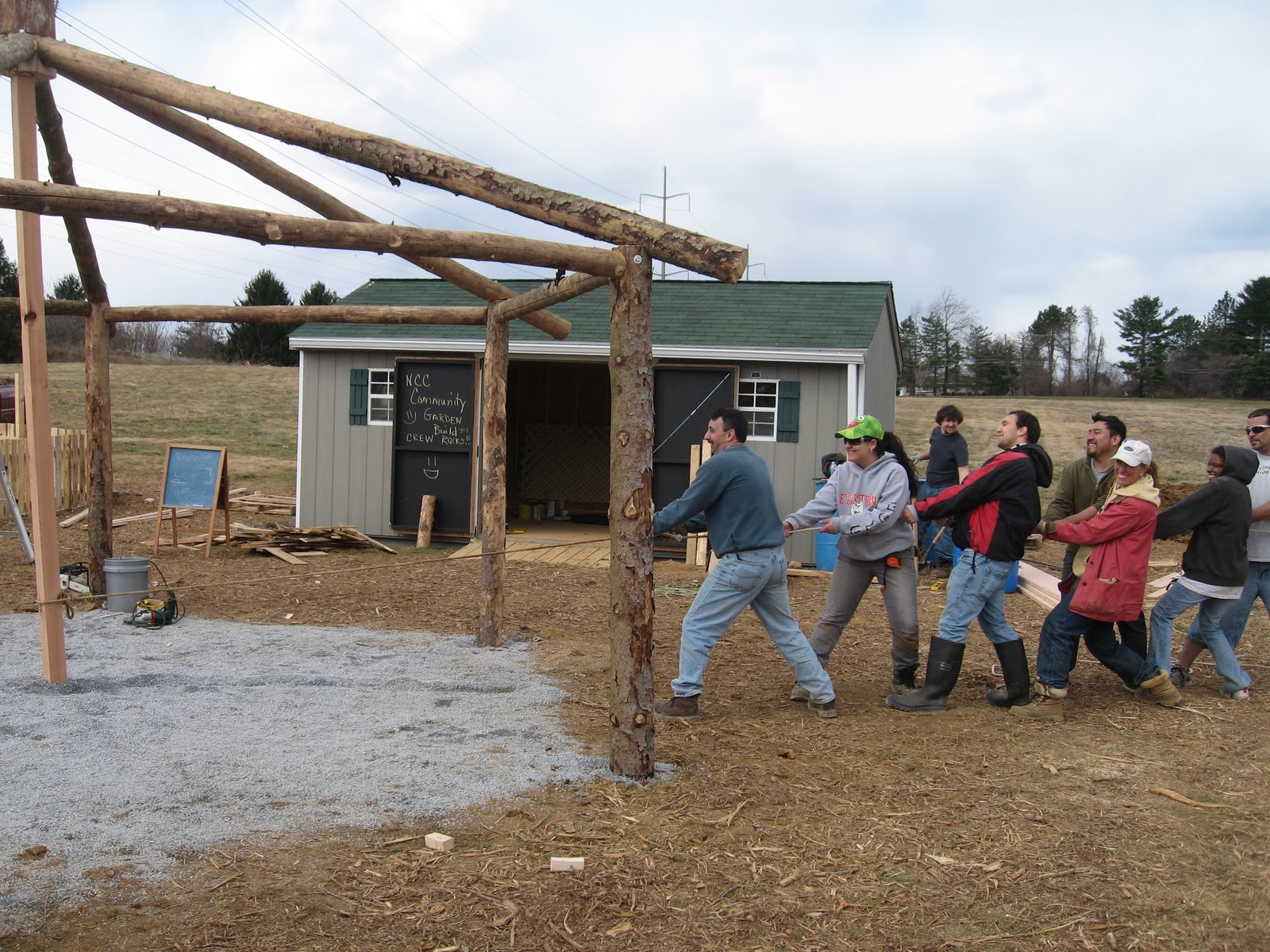


Obviously a great deal of attention went to the construction of the pergola. I'll have more detailed photos when the build is over.


.jpg)

Earlier this month Meg and I took a trip to Philadelphia so we could meet Era (from E.r.r.a.n.t) who is a community garden organizer and blogger. As many of you know I am currently gathering information for a proposal to have a community garden built at my school. Era was kind enough to answer some questions, give some advice, and show us some gardens; all on a day that exceeded 100°F.


[side note] This post is a very roundabout way to talk about something completely unrelated to the first little paragraph.
Soon after the Spring Semester ended I started a writers' group. Every Friday at 10:00 a group of friends and I meet at a park right outside of downtown to share our writing. I wish I had some photos to show you of the park, but they all must be on Meg's camera. Please take my word for it that the place is beautiful.
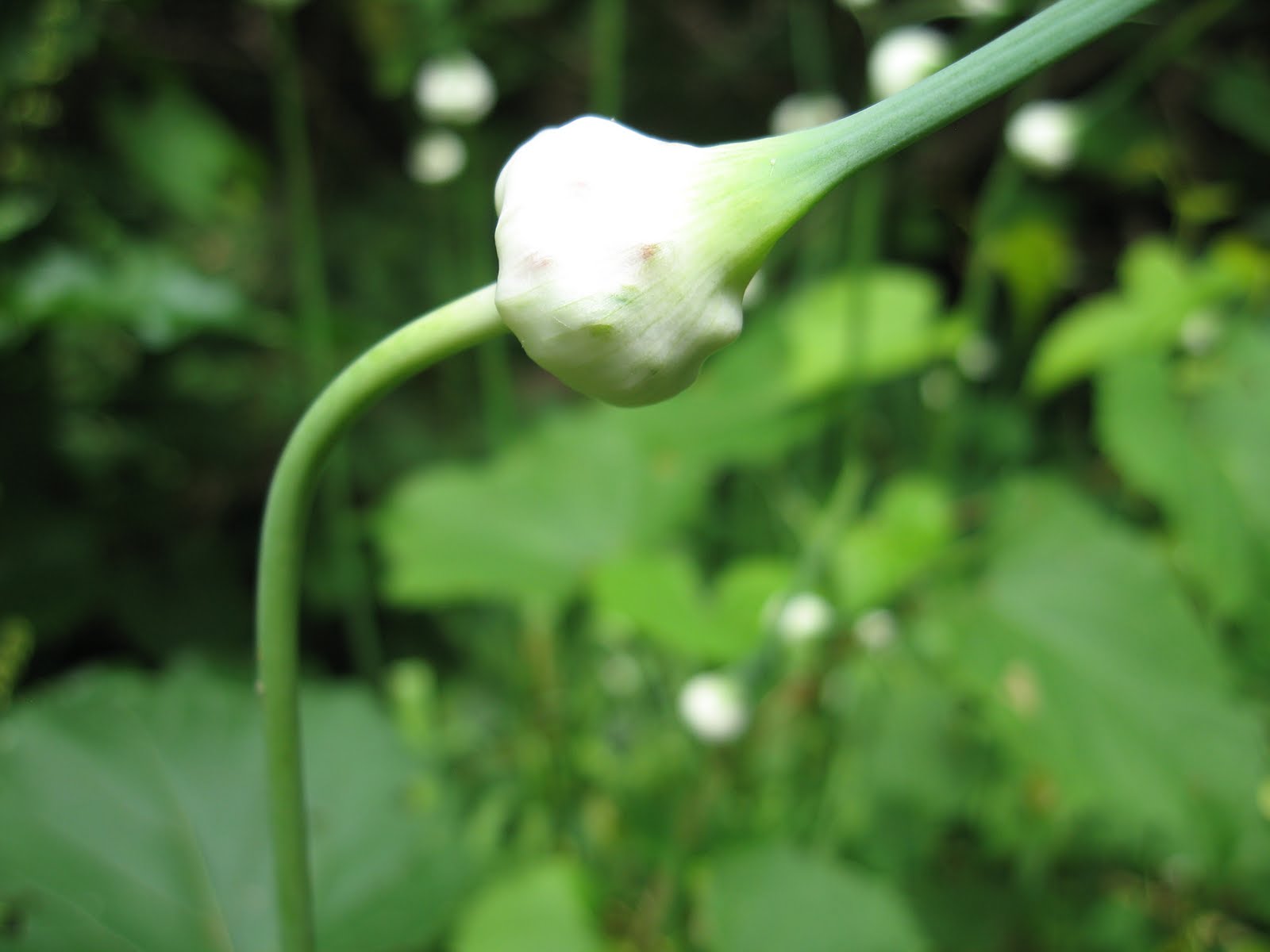
The park is close enough to home that I can walk, and on the way back I take a roundabout hike along the Monocacy Creek trails. Today on the walk home I was struck by a very pleasant and familiar aroma.


I think I'll need about three more of these posts and we should be up to speed.
Yes part one.
Where the hell has June gone? Well actually I know where it's gone, because it's a happy mess stored on our camera. Let's see what we can do to get caught up:

For those of you who follow this blog regularly, you know that I've been working on a proposal to start a community garden where I teach. In the past few months there has been an incredible (almost surprising) amount of progress. We have gained the support of the buildings and grounds folk, the cabinet (vp's and deans), and the president. Our next step will be to organize a group of students, staff, and faculty to create a final proposal and implementation plan for approval by the board and the president.
Between now and the beginning of next semester I need to visit some community gardens and speak with community garden organizers to gain a concrete understanding of how a project like this is built and sustained. A student leadership group at the school has already communicated with ten schools that have community gardens to build a base model of what this thing could be, but I would really like to speak with some people so I can get a personal sense of the big picture.
So, if any of you are involved with community gardens and have time to share your knowledge, please send it my way. If any of you live in Philadelphia, New York City, or their surrounding areas, I would love to visit and talk. Thanks in advance.

A couple weeks ago we were invited by some of the folks at Crayola to do a little garden workshop for kids. The event was targeted towards teaching kids how to live healthy. There were all sorts of workshop activities designed to show kids how play is exercise, how nature is cool, bike safety, and other stuff like that.


Last week a colleague and I met with one of the academic deans to discuss our proposal to reclaim a piece of land owned by the school that is mowed and sprayed and nothing else. The feedback we received has us going in a very positive direction. One suggestion she gave us was to have a "phase one" plan to our proposal that asks for a small part of the property as a sort of test for the eventual large scale project. She said the administration would be more likely to try small before they go big.
The question now is what small piece would we want to ask for and what would we do with it. I'm thinking that the area north of the block of trees would be a good place to start. That little splotch that looks like a dirty thumbnail print is actually a giant puddle. I would like to dig the puddle out and convert it into a pond so we can attract more wildlife and also so we have access to water. Access to water is big.
Beyond that, I'm not quite sure where to go. I think it's one of those cases where there are so many possibilities that it's hard to pick just one. We do have a list of wants/wishes:
Let the catching up begin.
It's been a while so I figured that I would start with the most insane of projects and then let the rest of what we've been up to settle in from there.
This is a Google Earth shot of where I teach. To the left of the photo is a large portion of the school's buildings and the tract of land on the right is what I hope the school will let me garden. I'm not sure how many acres in all we're looking at, but I walked it the other day and I gotta say that it's pretty massive.
Currently the area is mowed on a regular basis and sprayed for god knows what. One of my colleagues told me that there is some kind of law against dandelions in our area, so maybe the chemicals are to keep them down (yeah, let's not go there). 
This is the field on the lower right corner of the Google Map and...
this is the field on the upper right corner.
This (I know the photo quality is terrible) is a pond-sized puddle that you can actually see in the Google image. If there is enough clay content to the ground I will probably propose that we take a backhoe to this spot and turn it into an actual pond so we can attract some wildlife and keep the amount of water in the area consistent.
My goal is not to plant food from fence to fence, but to create an area focused on wildlife, permaculture, and community garden food production. I'm still trying to figure out what that last one means. The school is dedicated to working with the community (the administration is pretty amazing) but I feel we could do more to teach people about basic sustainability.
Some of the ideas that have been tossed around are:

Yesterday Meg and I spent the good part of the day picking green beans at Blue Blaze Farm. We met the grower, Eric, at the farmer's market and bartered our labor for some of his excess produce. Eric and his wife Melody's farm is certified naturally grown and is about 5 1/2 acres. Meg and I don't have any intentions of becoming market farmers, but we do want to grow food on a large scale. We figure that a couple years head start would eliminate some of the growing pains new farmers experience when they start with little to no knowledge of sustainable food production.
For those of you who are interested in this kind of cooperative farming, we should provide this little side note. Farmers obviously need to make money to keep their operation going, so I'm not too sure how open they would be to people flooding their stands and asking for food in exchange for labor. Rob from One Straw had a great post that kind of hits on this little dilemma. I think our case with Eric and Melody might be a little unique. They have a new baby and this is their first year growing full-time (this is their only source of income); their production needs have increased, but their ability to input labor has not. Perhaps when their baby becomes a little less time consuming (is that even possible?) they both can be out there together more often. Until that time comes, hopefully we can help them out on occasion.
Crazy. In our last post, which we just put up moments ago, we had talked about a community garden in our area. Shortly after I saw this little gem on Born to be Nervous. It's pretty cool; check it out.
On our way back from a day at Musikfest we walked by a little community garden. Their space is along the fence of a neighborhood playground. The garden is about four feet deep and half a city block long. We hung out and talked with one of the volunteers and she said that the garden runs on a pretty lax policy of plant what you want, pick what you want. The whole set up is simple and kept up well, but what really got our attention were the number of honey bees and the incredible sound of a neighbor practicing the sax.

We have a great little book shop in our city—it's actually the oldest continually-operating book store in the world. Yesterday, when we walked into town to order a few books, we realized that we ought to be blogging about some of the locally-owned businesses nearby.
The ease and convenience of shopping at independent businesses is kind of new to us here, as our previous abode was in the middle of a strip-mall wasteland (except for our favorite brewery and book store). Now, we've got a completely opposite situation—the chain stores are actually more out of the way and annoying to get to, which is no loss for us. Stay tuned for more posts about cool places in our neighborhood.

For those of you who get into limited series, be it on the television or the radio, you may enjoy this. My Aunt Terri and Uncle Rich are posting what, for the time being, will only be a one-month blog titled Nagel's Double Image Photography. If I have my information straight, the blog is a photo journal of sorts of their trip following the glacier path from Glacier NP to Olympic NP. The Journal is part of a grant my aunt applied for and I’m not to sure what they have to do with the information once the trip is complete. But here is what info I did get from her in a recent email:
I applied for a teacher creativity grant from Eli Lilly Corp here in Indiana- they review and approve 150 or so grants every year from the 500+ applications received. You know I love photography so it was easy to write a mission statement with passion. Anyway it was approved first try! I was fortunate since so many people I know say they were not approved until after several tries if at all. The grant was for $8,000 and I submitted a budget with the proposal that covered the costs estimated. It bought photography equipment and materials but we have used a large portion of it for diesel fuel which has gone up about 25-30% since I wrote the grant. Such is life but we are having such a wonderful time that we wondered if we won't do this at least 50% of our time when we retire! Such an awesome country we have full of beauty that soothes the soul indeed! Anyway we are having a great time learning new things like blogging and using this upgraded digital equipment, and of course sharing our experiences with good friends and family.


A short while ago Meg and I started reading a blog that has added a whole new element to our blogging experience. Cold Splinters is a new blog (shit, who am I to say a blog is new, we've only been around a year) that provides a unique and challenging lens with which to view the everyday.
Wait.
What do I mean?
Hell, I don't know. I've been trying to formulate a reason why I like this blog so damn much, but I really haven't found the vocabulary. How about this:
If it grabs you, it will grab you good. Meg and I read a lot and we appreciate good writing. Cold Splinters is very smart writing equipped with fantastic music. Just last week I was humming Belle and Sebastian tunes for days. This is the first blog I've read that amalgamates songs as part to the message of the post. The photo above was matched with Paul Simon's "Obvious Child." Enjoy.
Well, we were hoping to get in another solid day in the garden today, but no such luck. The weather was just a little too miserable for yard work. Our next outside hurrah will be to plant our brassicas in their respective beds and erect the new bamboo flagpole. Hopefully we can get to it on Friday.
In the meantime, there are a few blog activities I wanted to give a shout for.
The first is actually long overdue. Kelly at Her Able Hands is putting together a project involving photos of your hands and a narrative to go along with it. I don't remember end result she is looking for when she has collected the submissions, but what ever it is, we gardeners have a very special relationship with our hands and I thought it would be cool to see those stories collected in some fashion. Meg and I are trying to get our submission together, but midterm grading and job searches have rudely gotten in the way. I don't think she has a time frame for any kind of deadline, but I'm sure she doesn't want to sit on it indefinitely. Kelly, if it's not too late we will get one out soon.
The second activity involves the Mouse & Trowel award, which Path to Freedom reminded us about on their journal. Meg and I are having great fun with the challenge of posting every day and we have had even more getting to know all of you. So, if you feel like giving a shout to some of your must-read blogs, this would be a wonderful way to do it. I usually don't believe in awards, I'm a mild socialist, but Path to Freedom has been a positive force for us in the garden blog world and any award they feel fit to promote is alright by me.


On my train ride to and from work I pass through Philadelphia's unfortunate ring of garbage. I've begun to mentally catalogue the trash, deciphering what could be recycled and reused. Quite often the reuse qualities are garden related. Meg and I try to reuse before we buy new and this often involves creative scavenging*.
Along with the ring of trash there are also the overwhelming number of abandoned factory and apartment buildings. As the title of the post suggests, I think something should be done to utilize (recycle and reuse) all of this unused space. In my early teens I went with my church to Yonkers, New York on a two week mission trip to help reclaim abandoned homes and turn them into affordable housing. The program was called S.W.A.P. (Stop Wasting Abandoned Property) and it was created and run by a local Presbyterian pastor. What little funding they had came from donations. They were able to stretch that funding with recycled and reused materials. After experiencing what can be done with a little pride and inventiveness, I have to ask myself why we're building new (suburban sprawl) when we could be rebuilding.
Granted, a good deal of these abandoned properties are in low income, high crime areas that most suburbanites try to avoid (I'm sure we could all hypothisize why there is this divide). I believe that when cultural and ethnic diversity is embraced, it makes the community stronger. When I volunteered for SWAP, even as a teenager, I noticed how much a neighborhood could come to life when the people who live there have pride and purpose invested in where they live. So what if instead of building homes, an organization was developed to build gardens. I think it would be cool if each of these neighborhoods were to reclaim one of these buildings and turn it into a community garden. I'm sure this has already been done**, but what would it take to provide this opportunity to all communities?
Imagine if a community were to receive a grant to purchase a building, have is torn down, and turned into a community garden to replenish their local food cupboard (let's not forget that poor nutrition is also an issue in lower income neighborhoods). Many of these buildings are made of brick. The bricks could be used to make rows between the beds and stacked to make the actual raised beds. Then there is the ring of garbage to be utilized to make trellises, tomato cages, curing tables, work benches, bird baths, rain harvesters, and all kinds of other stuff.
There is no way Meg and I could run a project like this on our own, nor would we want to, but we are curious to know how we could get it started. If any of you have ever seen anything like this done and have some suggestions, please share. Thanks.
*Check out Patrick's post on the environmental benefits and hazards of the materials we choose to use or reuse in the garden. His post specifically targets PVC.
**I've actually been tossing this post draft around for a little while now and in the meantime read two posts that touch a bit on this subject. The first was from In the Toad's Garden and it talks about a mobile community garden. The second post is from Fast Grow the Weeds, which doesn't really talk about community reclamation (it's about saying enough to petty excuses and getting out there and doing something), but Ali from Henbogle (you've got to see her reclaimed sink) had a comment to the post that does point to some of the potential hazards of such a project.


